The toughest Algebra 2 Regents questions usually are not testing one brand-new skill. They ask you to connect familiar ideas, choose a method, and keep your work organized from start to finish. For strong Algebra 2 Regents prep, focus throughout the school year on the topics that need the most reasoning: transformations, polynomial and rational equations, exponential models, trigonometry, and statistics.
A sustainable routine helps difficult material feel more manageable over time. Learn each unit deeply when it is taught, revisit it periodically, and add mixed-topic problems after new units. Maintain an error log, then schedule cumulative review before benchmark tests and the Regents exam.
Build Understanding of Tough Regents Skills
We often see students struggle not because they “cannot do math,” but because a question has several steps. A graph may need to be read before an equation can be written. A word problem may require you to decide what information matters. Even small notation errors can change a correct answer into a wrong one.
The most helpful year-round study plan combines a few different habits:
- Review the idea behind a skill, not just the steps
- Work on official released Regents-style questions after learning each unit
- Check missed problems carefully instead of only looking at the answer
- Keep practicing mixed topics, since the real exam does not group every skill together
Memorization has its place, especially for formulas and special angles. Still, confidence with difficult material comes from recognizing what a question is asking, understanding why a method works, and avoiding recurring errors.
Decode Function Transformations Through Year-Round Practice
Function transformations can feel backward at first, especially when changes happen inside the function. Outside changes are usually more direct. In f(x) + 3, the graph moves up 3 units, while f(x - 3) moves right 3 units despite the subtraction in the equation.
That inside-out rule causes plenty of confusion. Reflections, stretches, and compressions can make it even harder when several transformations appear at once. Rather than trying to sketch everything from memory, start with the parent function and work in a clear order.
Choose a few key points on the parent graph, then apply one change at a time. A short table can help you track where each point moves. This method is especially useful with quadratic, absolute value, square root, exponential, and trigonometric functions.
Regents questions may show the same idea in several forms. You could be asked to match an equation to a graph, identify zeros, compare maximum values, or describe a shift in words. Connecting equations, tables, and graphs helps you see that these are all versions of the same skill. Revisit transformations whenever you begin a new function family, and include a few older transformation problems in later mixed practice sets.
Make Polynomial and Rational Equations Manageable
Polynomial questions reward neat work because they often require students to identify a pattern before choosing a method. Before solving, organize terms in descending order, identify the degree, and look for a greatest common factor. Then decide which approach fits the expression. It may call for grouping, a special product, synthetic division, or the factor theorem.
Rushing is the biggest problem here. One missing negative sign or incorrect factor can affect every step after it. Pause before expanding or factoring and ask, “What pattern do I see?” Record sign errors, factoring mistakes, and incorrect method choices in an error log so you can revisit those patterns during the year.
Rational equations need another layer of care: excluded values. Any value that makes a denominator equal zero cannot be part of the solution. Write those restrictions down before simplifying or cross-multiplying, then check your final answers afterward.
Zeros also matter beyond the algebra. A zero can be:
- A solution to an equation
- An x-intercept on a graph
- A point where a real-world quantity reaches zero
Practicing all three meanings throughout the year prepares you for questions that switch between symbolic work, graph reading, and written explanations. Add polynomial and rational equation questions to cumulative review before benchmark tests so earlier methods stay familiar.
Solve Exponential, Logarithmic, and Trigonometric Questions Confidently
Exponential models often look complicated because the story around them is long. Start by finding the structure. In a model such as y = abˣ, a is the initial value and b is the growth or decay factor. A multiplier greater than 1 shows growth, while a multiplier between 0 and 1 shows decay.
Be careful with percent language. A percent increase is not the same thing as the decimal in the equation. If a problem says a quantity grows by a certain percent, you need the correct multiplier before solving anything else.
Sometimes you can solve an exponential equation by rewriting both sides with a common base. When that is not possible, logarithms help isolate the variable. Use parentheses carefully on the calculator, and wait to round until the final answer. Just as important, read what the question wants. Is your answer an amount, a time, or a rate? Practice these question structures again after logarithms are introduced, since revisiting both topics helps connect the methods.
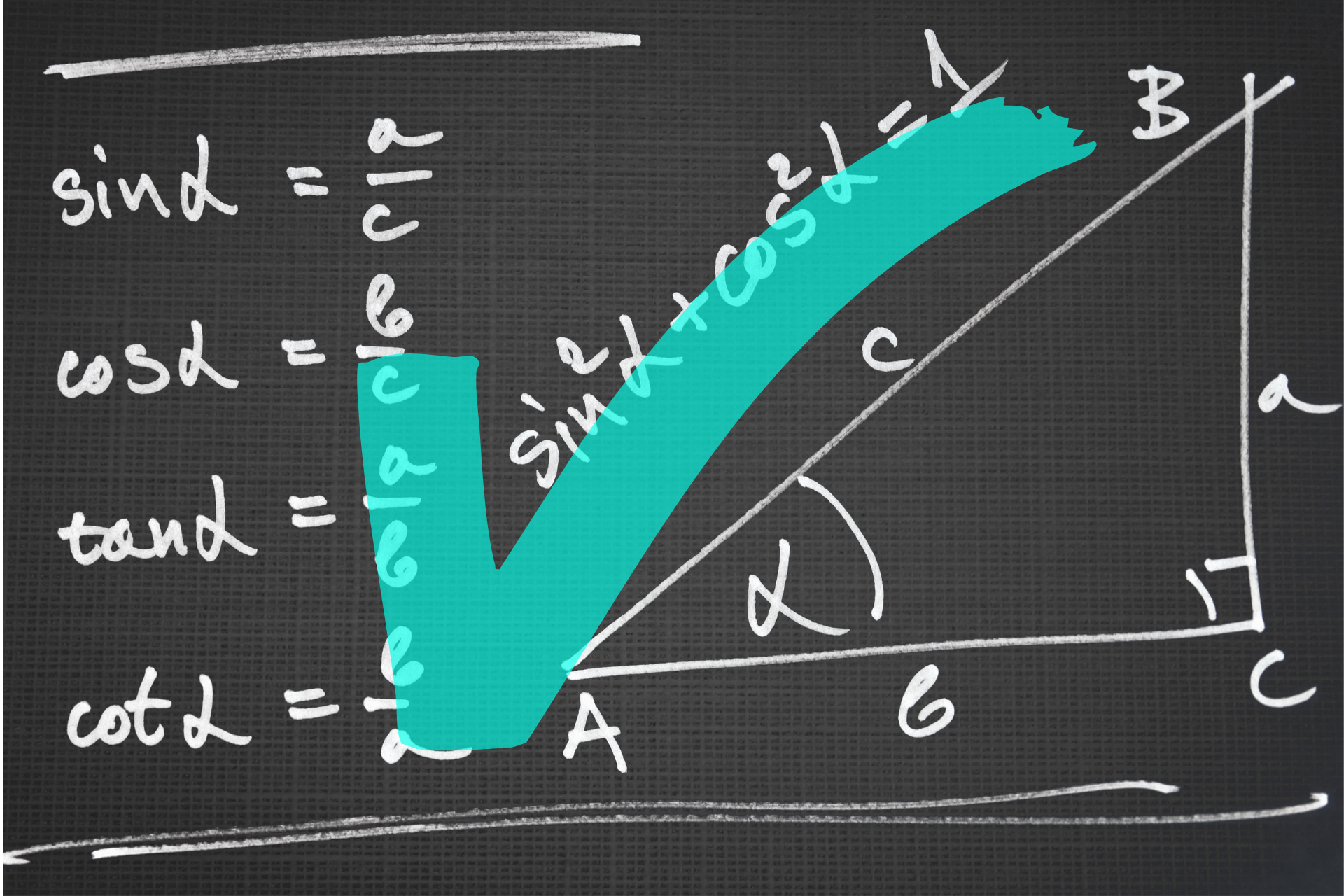
Trigonometry brings together geometry, algebra, and graphs. Rather than memorizing random steps, focus on meaning. Sine, cosine, and tangent compare sides of a right triangle. The unit circle helps you find exact values and understand positive and negative signs in each quadrant.
For trig graphs, practice identifying amplitude, period, midline, and maximum or minimum values. A graphing calculator can help verify a solution, but you still need to show the reasoning that leads there. Reference triangles and common-angle patterns are more useful than trying to memorize isolated values. Return to special angles and trig graph features periodically, especially when mixed-topic practice reveals gaps.
Strengthen Probability, Statistics, and Cumulative Review
Probability and statistics questions can look simple, then become tricky because of wording and multi-step problem structures. Before choosing an operation, decide whether events are independent, dependent, mutually exclusive, or conditional. Tables and tree diagrams can make the information easier to sort.
With normal distributions, read closely to see whether the question asks for values above, below, or between given points. Know what mean, standard deviation, z-score, and percentile mean before relying on calculator output. The same rule applies to regression: a correlation coefficient, residual, or predicted value needs an explanation tied to the situation.
For Algebra 2 Regents prep, rotate through one hard topic per study session, then end with mixed questions. Keep an error log for problems you miss. Label each mistake as a concept gap, calculator error, sign error, misread question, or incomplete explanation.
That record turns “I’m bad at this unit” into a clear next step. Focus on the error patterns you see most often, revisit the underlying skill, and give yourself enough time to practice it again. Before benchmark tests and the Regents exam, use cumulative review to reconnect probability and statistics with the other difficult topics you have studied throughout the year.
Build A Clearer Path To Regents Confidence
Math Exceed offers personalized
Algebra 2 Regents prep that helps students strengthen core concepts and approach challenging questions with greater clarity. Our tutors tailor each session to the skills that need the most attention, from functions and logarithms to probability and trigonometry.
Contact us to discuss a tutoring plan that supports steady progress throughout the school year.